Thirty minutes before the dinner meant to celebrate fifteen years of marriage, Malcolm Reed looked his wife directly in the eye and said four words that would end everything. Pack your bags tonight. He expected tears. He expected pleading.
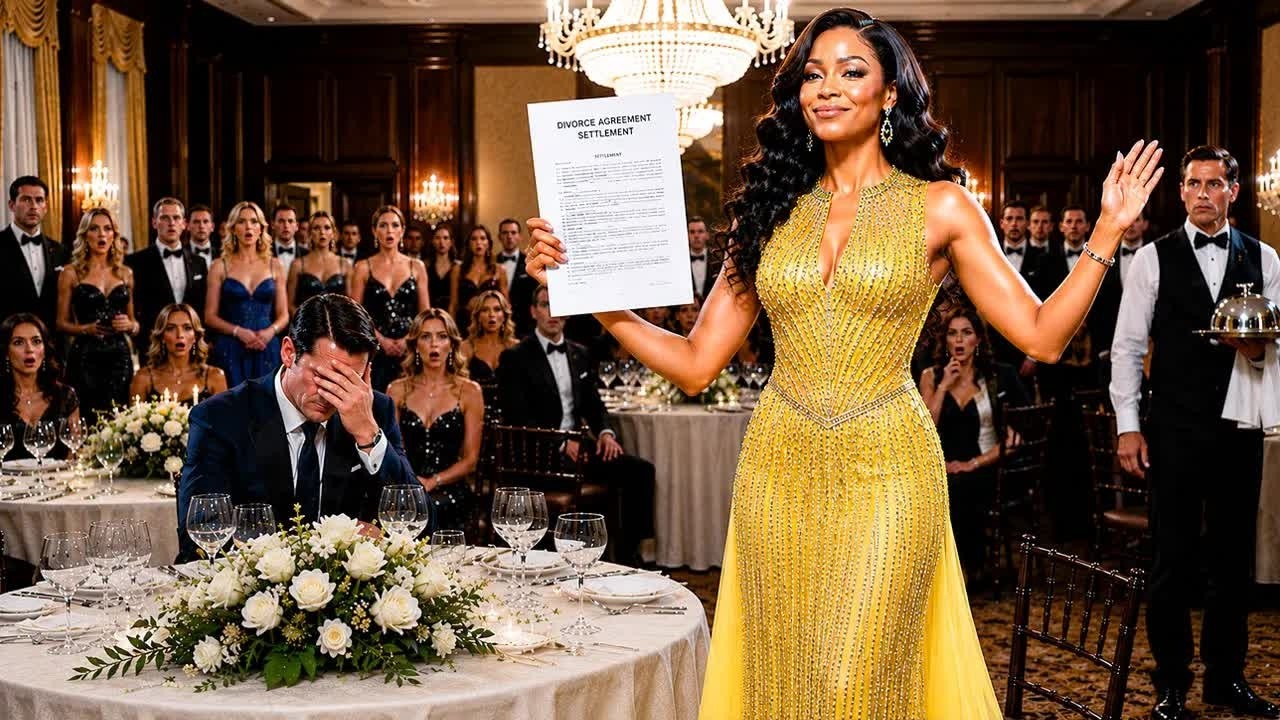
He expected the woman he had married to unravel quietly and disappear from the life they had built together in Atlanta. What he did not know was that Immani Brooks had walked out of a divorce attorney’s office three months earlier, carrying a file she had prepared in silence, one careful step at a time. When the appetizers arrived that evening, she did not offer him an apology. She placed a signed set of divorce papers on the white tablecloth between them, and the smile on his face disappeared before the entrée was ever served.
By the time dessert should have arrived, his entire world had already started to collapse. Fifteen years earlier, Immani Brooks had walked down the aisle believing she was building something permanent. She was young then, ambitious, already showing the instincts that would one day make her one of Atlanta’s most sought-after interior designers. Malcolm was charming in those early years, hungry for success, and Immani had been the quiet architecture behind his rise.
She turned down a partnership offer from a design firm in New York so she could stay close while he climbed the ranks at his company. She hosted the dinners that impressed his superiors. She smoothed over the awkward silences at company galas and learned the names of every executive spouse. For years she believed marriage meant both people carried weight, even when that weight was invisible to everyone watching from the outside.
Somewhere along the way the balance shifted, and she felt it long before she could name it. Malcolm’s phone began resting face down on every surface, a small habit that had never existed before. His late nights at the office multiplied, then doubled. Business trips that once lasted two days stretched into five, then a full week, with vague explanations about restructuring and board pressure that never quite added up.
He answered questions in half sentences. His eyes drifted somewhere else when she spoke to him at dinner. She was not a woman who jumped to conclusions. She had built a career on patience, on reading a room before making a move.
So she watched. She waited. She said nothing. There were smaller moments too, ones she almost missed because they arrived disguised as ordinary irritations.
Malcolm stopped asking about her design projects, the ones he once claimed to admire. He grew impatient during conversations that used to hold his attention, checking his watch, answering in clipped sentences that carried none of the warmth she remembered. Friends began commenting gently that they rarely saw the two of them together anymore, that Malcolm seemed to attend industry functions alone. She absorbed each comment quietly, filing it away the way she filed away every other piece of evidence her instincts refused to ignore.
Then, without warning, Malcolm did something he had not done in years. He made a reservation at the restaurant where he had proposed fifteen years before on a rainy October evening. He told her to wear the blue dress she had worn that night. And for a moment something in her chest loosened, some old hope she thought she had buried resurfacing without permission.
Perhaps he wanted to fix things. Perhaps the distance of the last two years had frightened him too. She allowed herself, just for an afternoon, to believe the man she married might still be somewhere inside the stranger he had become. That afternoon arrived gray and quiet, rain tapping against the windows of the house they had shared for over a decade.
Immani stood in front of her closet, running her fingers along the blue dress, remembering the way he had once looked at her in it. She curled her hair, applied her makeup, and allowed herself one more evening of hope. Downstairs she heard the front door open and close, his footsteps heavier and more deliberate than usual. He walked into the bedroom, and everything about his posture told her this evening would not unfold the way she had imagined.
He set his keys on the dresser. He did not compliment the dress. He did not mention the restaurant or the rain. Pack your bags tonight, he said, his voice flat, almost bored, as though he were reading from a list of instructions.
She felt the air leave her lungs, though her face remained perfectly still. Malcolm continued, filling the silence she refused to fill. He told her he needed space. He was tired of pretending, tired of a marriage that had grown stale years ago.
He told her not to make this difficult. Then, almost as an afterthought, he added that the house should remain his, since his income had always outpaced hers. She did not argue. She did not raise her voice.
She simply nodded once slowly and allowed a small, unreadable smile to settle on her lips. It unsettled him more than any scream could have. Some distant part of him registered that something was wrong with her calm, but he pushed the thought aside, eager to believe the evening would proceed exactly as he had planned. He turned and walked out to finish getting ready.
The moment his footsteps faded down the hallway, she reached for her phone and dialed a number she had memorized weeks ago. It’s time, she said quietly. On the other end, attorney Simone Ellis simply asked one question. Are you ready?
And Immani, staring at her own reflection in the blue dress, answered without hesitation. Three months before that rainy October evening, her world had already begun to crack, though she alone knew it. It started with a hotel receipt tucked into the pocket of one of Malcolm’s jackets, a charge for a suite downtown on a night he claimed to have been working late. It was a small thing.
But she had spent fifteen years learning her husband’s patterns, and this one did not fit any story he had ever told her. She said nothing. She folded the receipt back into the pocket exactly as she had found it. Over the following weeks more pieces surfaced, each small enough to dismiss on its own but together forming a picture too clear to ignore.
An email left open on a shared laptop, hastily closed. A photograph on his phone, angled away too quickly, showing him laughing beside a woman she did not recognize. She learned the name eventually. Celeste Vaughn, a vice president of marketing at his company.
Ambitious and calculating in ways that mirrored Malcolm’s own hunger for status. She did not confront him. Instead she did something far more dangerous to a man like Malcolm. She prepared.
She hired a private investigator through a discreet referral. Within weeks she had photographs, hotel records, and a timeline stretching back over a year. She read every page alone late at night after her staff had gone home, allowing herself exactly one hour to feel the full weight of what she was learning before closing the folder and returning to the calm, composed version of herself the world was accustomed to seeing. She met with Simone Ellis, one of the most formidable divorce attorneys in Georgia, in a quiet office far from anywhere Malcolm might recognize a face.
Together they built a case with the same discipline Immani brought to every client contract. Simone warned her early on that the process required patience, that Malcolm would need to believe right up until the final moment that he still held all the power. Behind the scenes she made moves he never noticed because he had never once thought to look. She consulted her longtime financial adviser, Victor Hale, a man who had guided her investments since before she ever met Malcolm, and quietly ensured that key assets, accounts, and business interests were protected under her name alone.
She backed up years of financial records. She transferred ownership structures on several investments that had technically been funded by her own earnings from the very beginning. Malcolm, meanwhile, continued his affair with a confidence built entirely on the assumption that his wife was too soft, too devoted, too afraid of being alone to fight back. He mistook her silence for surrender, never once imagining that the same discipline she used to build his career was now being turned methodically against him.
In their final planning session, Simone looked across the desk and delivered the only instruction that mattered. When he asks you to leave, she said, don’t. The restaurant glowed with the same warm amber light she remembered from the night he proposed. Malcolm walked in ahead of her, shaking hands with the host, requesting the same corner table where he had once knelt before her.
He had rehearsed this evening carefully. He intended to announce their separation with the same polished ease he used in boardrooms, framing himself as the reasonable party while she absorbed the blow quietly the way she always did. What Malcolm did not know was that Celeste Vaughn sat at the bar across the room, dressed impeccably, sipping wine. She had insisted on being nearby, eager for the night their relationship could finally step out of the shadows.
He had told her this dinner was a formality. The waiter poured the wine, recited the specials, and disappeared. Malcolm lifted his glass in a small, theatrical toast, thanking her for fifteen years, his voice carrying the practiced warmth of a man delivering a speech. She lifted her own glass, her expression giving nothing away.
The appetizers arrived, and he began his rehearsed speech, speaking in measured tones about growth, about needing space, about a marriage that had run its course. He spoke as though he were doing something noble, ending their marriage as an act of honesty rather than betrayal. She listened without interrupting, calm, almost serene. When he finally paused, waiting for the tears he assumed were coming, she reached into her bag and withdrew a plain white envelope.
She placed it on the table between them and slid it across the linen until it rested beside his glass. He stared at it for a long moment before picking it up. Inside were divorce papers already signed, dated weeks earlier, along with a thick stack of supporting documents. Photographs.
Hotel records. Timestamped messages. Everything the investigator had gathered. His face drained of color as he flipped through page after page, watching his carefully hidden affair laid bare in black and white.
Across the room, Celeste noticed the shift in his posture and felt her stomach tighten, though she did not yet understand what had gone wrong. For the first time in the fifteen years she had known him, Malcolm did not have a response prepared. His anger arrived a moment later, hot and defensive. He accused her of scheming, insisted she could never afford an attorney capable of matching the legal team his family’s money could buy.
She said nothing, simply reached for her water glass and took a slow, deliberate sip. He leaned forward, lowering his voice into something sharper, warning her she had no idea what kind of legal battle she was inviting into her life. She met his gaze steadily, unbothered, and reached for her phone, sending a single brief message before setting it face down. Then, exactly on cue, the restaurant’s front door opened.
Attorney Simone Ellis walked in, composed and unhurried, dressed in a sharp charcoal suit. She crossed the room and took the empty seat beside Immani as though she had been invited all along. She set down a leather folder with a quiet, deliberate thud. His face shifted from anger to disbelief as Simone opened the folder and began laying out documents across the table.
Records of Immani’s separately held assets. Verified proof of financial contributions to the marriage no one had bothered to track. A detailed report from the investigator complete with dates, locations, and names. When his eyes finally lifted from the documents, she offered him only one more sentence before closing the folder.
There’s one more document you haven’t seen yet. Something cold settled in his stomach. The following morning, Victor Hale arrived at Simone’s office carrying a briefcase filled with financial records spanning the entirety of the marriage. He sat across from Malcolm and Simone and explained in patient, measured terms that many of the investments Malcolm had long assumed belonged jointly to the marriage actually traced back to funds Immani had earned and managed independently through her firm.
The seed capital for several real estate holdings. The initial investment portfolio Malcolm often bragged about at dinner parties. Even the majority of the down payment on the house itself had originated from her earnings, structured carefully under her name from the very beginning. Every transaction was properly recorded and legally sound.
Malcolm sat frozen, listening to a version of his own financial history he had never understood. He tried briefly to challenge the figures. Victor simply slid another folder across the table containing the original transfer documents, each bearing Malcolm’s own signature. He had signed countless documents without ever truly reading them, trusting his authority so completely that he never imagined anyone might structure things in a way he had failed to notice.
Across town, Celeste Vaughn sat at her desk when her phone buzzed with a call from human resources. Questions had arisen regarding conflicts of interest between her department and Malcolm’s. An internal investigation would begin immediately. Word of the collapsing marriage spread through Atlanta’s business circles faster than either of them could have anticipated.
Executives who once sought his opinion grew quiet whenever his name came up. Celeste found herself formally investigated, her position suddenly precarious. Malcolm was placed on administrative leave pending review. Through all of it, Immani said nothing at all.
She did not appear at industry events to share her side. She did not seek sympathy. Instead she returned to her design firm the following Monday morning, greeting her staff with the same steady warmth she always carried. Her silence became the loudest thing in the entire situation.
Rumors multiplied in the absence of her voice, most of them favorable to her, painting Malcolm as a man who had thrown away a woman of substance for someone far less impressive. Three weeks after the disastrous anniversary dinner, unable to bear the silence any longer, Malcolm drove to the house that was no longer entirely his and knocked. He asked quietly, without his usual arrogance, if she would speak with him one final time. She opened the door and studied him for a long moment before stepping aside to let him in.
He looked smaller somehow than she remembered, the weeks of professional collapse visible in the tired lines around his eyes. He sat across from her in the living room they had once decorated together, and for the first time in years he spoke without pretense. He admitted he had foolishly believed she would always forgive him, that her devotion was a constant he never needed to question. He admitted he had never truly imagined a version of his life where she simply decided to leave.
He spoke of Celeste with something close to embarrassment, admitting the affair had never been about love, only about the intoxicating feeling of being wanted by someone who did not yet know his flaws. She listened without offering the reassurance he seemed to be searching for. She thought of all the years she had spent making herself smaller so he could feel larger, of all the ambitions she had quietly set aside. She felt no anger anymore, only a kind of tired clarity about how much of herself she had once been willing to give away.
When he finally finished, she offered him only a single sentence, delivered with quiet, devastating clarity. You didn’t lose your wife tonight, she said. You lost her months ago, the night you decided I wasn’t worth telling the truth. He sat in silence, unable to find words.
She rose, walked to the writing desk near the window, and retrieved the final document requiring her signature. She signed her name with the same steady hand she had used on the night of their anniversary dinner. The divorce proceedings moved through the courts with surprising speed, because Malcolm’s legal team, faced with the overwhelming documentation Simone had assembled, advised him against dragging the case into a prolonged public battle. Each hearing chipped away at whatever leverage he believed he still possessed.
Immani retained ownership of her design firm entirely, along with the majority of the investments Victor had protected. She kept her dignity intact through every hearing. Malcolm grew increasingly withdrawn, his confidence replaced by a quiet, permanent unease. When the final ruling was delivered, he left the courthouse alone.
Celeste had already ended things weeks earlier, unwilling to remain connected to a scandal that had cost her a promotion and nearly her entire career. She left the firm quietly and relocated to another city. Malcolm, for the first time in his adult life, found himself entirely alone. In the months that followed he began to understand something he had never allowed himself to consider during all his years of ambition.
The most valuable thing he ever had was not his salary, his title, or his name on a deed. It was the woman who had stood quietly beside him for fifteen years, building a foundation beneath his success he had never once bothered to examine. A year passed. Immani expanded her company into three additional states.
Her name became recognized throughout the industry as both a creative force and a shrewd businesswoman. She hired new designers, mentored young women, and built a culture that reflected the values she had fought so hard to protect. She began speaking at conferences about women navigating leadership in male-dominated industries, sharing lessons drawn not from theory but from the quiet resilience she had lived through. She never mentioned Malcolm by name.
On a cool evening in late autumn, almost exactly one year after the dinner that ended her marriage, she attended a charity gala in one of Atlanta’s grand ballrooms, dressed in a deep emerald gown, invited as a guest of honor for her firm’s contributions to a housing initiative. She moved through the room with the same quiet confidence that had carried her through the most difficult months of her life. Across the ballroom, almost by accident, her eyes met Malcolm’s. He looked older than she remembered.
He crossed the room slowly, approaching with none of the arrogance that had once defined him, and they stood facing each other for the first time since the divorce was finalized. Do you ever miss us? he asked quietly. She considered the question for a moment, searching for honesty within herself before she answered.
I miss who I thought we were, she said finally. Not who you became. She offered him a small, genuine smile, one that carried no cruelty and no lingering resentment. Then she turned and walked back into the crowd, leaving him standing alone near the edge of the ballroom.
Later that night, driving home alone through the quiet streets of Atlanta, Malcolm thought back on the version of himself who once stood in a bedroom doorway and told his wife to pack her bags, never imagining that the woman he underestimated would be the one walking away steady and unafraid. Immani drove home with the windows cracked, letting the cool autumn air move through the car, feeling nothing but a quiet, settled contentment with the life she had rebuilt entirely on her own terms. She thought of the years she had spent believing her worth was measured by how much of herself she was willing to give away, and how far she had traveled since the night she finally chose herself instead. There was no bitterness left in her, only the steady, hard-earned peace of a woman who had learned that the strongest response to betrayal was never rage.
It was preparation. It was patience. It was walking away, calm and certain, exactly when the moment finally called for it.